Page 2 of 3
Boston, Massachusetts
Does it put the Ram in the Rama-Lama-Ding-Dong?
For me, AIA25 is nonstop for four action packed days that start early and end late, and this page of the slideshow really starts to focus down on the AIA part of my Boston trip. The non stop relentlessness of it is mostly a good thing and the reason I keep coming back, and that non stop relentlessness starts with the AIA25 Educational Tours.
My first tour this year was ET113 Conservation & Change: Boston City Hall and Plaza. If there was a category of Brutalism called Super Brutalism, then Boston City Hall by Kallmann, McKinnell & Knowles might very well be its poster child. For this the building is often referred to as the most hated in America, and also for this it is now thankfully landmarked.
The program started with an in depth historical background of the building where we learned that the architect once said that he would have even made the light switches out of concrete if he could. Once we started moving we went to all of the spaces you would expect to go, everywhere from the Eagle Room to the Mayor’s Office (she wasn’t there) to the Council Chambers, as the architects showed off renovation challenges throughout. And the tour even included the updated exterior plaza, a major improvement from what was there the last time I visited, yet one that doesn’t feel as out of place as I feared.
Next up was ET143 One Dalton: Skyscraper as Good Neighbor, which was all about One Dalton: Skyscraper and not all that much about being a good neighbor. Like all of the tours, this was led by the architects and designers (in this case from from Pei Cobb Freed) who worked on these buildings for decades and have so many good stories about every part of the design and construction. One Dalton sits on land owned by the Christian Science Church people and is a Four Seasons Hotel and Residences stacked in a tower just west of the Prudential Center. Our visit included the hotel public spaces and mechanical floors, but the highlight was an unfinished penthouse on the 61st floor with a double height covered balcony hovering over wonderfully uninterrupted views of the city.
This year the AIA moved their Open Studios program to the first night of the conference and I visited three of them starting with the best one: Payette. The office was in a good location (for me), they had lots of fun models on display and lots of good free food and drinks, and even a place to stand around (extra space to stand around is unusual in architecture offices). The other two offices (Wilson Butler and Touloukian Touloukian) were also good but unfairly suffered in comparison to Payette.
You wouldn’t know it from my slideshows, but AIA25 is more than just tour after tour after tour. There is a massive trade show (not pictured), all sorts of seminars (not pictured), networking opportunities (not pictured) and keynotes (pictured). The keynote speakers were a big step up from last year and featured an AI expert, an influencer and an infrastructure expert. The infrastructure expert was former US Secretary of Transportation Pete Buttigieg, whose presentation I went in with high expectations that he still managed to exceed. In a fair and just world he would be in a high leadership position right now, but until then, we’ll have to settle for him being a kick ass keynote speaker, probably the best one I’ve seen at an AIA conference to date.
The tours this year in Boston were really exceptional, and the centerpiece tour for me was probably ET152 Campus Transformations, Harvard University, which was a half day marathon of four tours jammed together. This epic half day started at the Smith Campus Center designed by Josep Lluís Sert with a renovation by Hopkins Architects. Since Sert has been dead for 42 years, the tour was led by the renovation architects as opposed to a ghost Sert or zombie Sert, which probably was for the best.
Sert is one of those modernists I know of but not one of those modernists that I know especially well, so seeing his work somehow felt new to me. And the even newer, shiny glass interventions seemed to work well with what was already there.
The tour continued to the Harvard Art Museums, where we generally stayed in the public areas (other than one exception) and we learned more about the building and its Renzo Piano addition than I could ever be expected to remember.
Right next door to the Harvard Art Museums is the Carpenter Center, Le Corbusier’s only American building and one that I have never been inside- it always seems to be temporarily closed and when I am there. One could make an argument based on my experience that the building is always closed to visitors and just the front for some sort of deep, deep scam that goes all the way to the top. And even though that argument is pretty terrible, nowadays terribly arguments seem to be all that you really need.
I’m using the word exhausting a lot in this slideshow and am getting ready to use it again. The Harvard blitz tour was exhausting, and to save you a little trouble we’ll skip right over the tour of the Harvard Divinity School (no offense intended Harvard Divinity School) and go right to the highlight: Gund Hall, home of the GSD, Harvard’s Graduate School of Design. Designed by John Andrews (who was also the architect of Toronto’s CN Tower) Gund Hall is an insane terrace of studios under a massive glass roof that was recently replaced. The students call the space a one room schoolhouse, possibly lovingly, possibly derisively, possibly both. But inside on a day with no students, the space was spectacularly weird in the best possible way. And the ground floor cafe at Gund Hall was named the Chauhaus, what’s not to love about that?
My next university tour the next day took me to MIT, specifically to the West Campus and the two recently renovated Eero Saarinen buildings on ET161 Saarinen’s Masterworks at MIT’s Kresge Auditorium and the MIT Chapel. The tour of the masterworks started at the Kresge Auditorium, which looks great after recently getting all fixed up, even if the acoustics inside remain reportedly terrible.
The MIT Chapel is just a terrific little building and one that really makes you wonder what else Saarinen would have produced if he didn’t die so young. What makes the inside of the chapel so special are two big things- Harry Bertoia’s altarpiece metal screen and the unusual detail at the curvy brick walls where hidden glass panels allow in light from the exterior reflecting pool below. That detail is borderline insane but simultaneously unquestionably brilliant. When you look at Saarinen’s work, which stretches from the TWA Terminal at JFK to the Gateway Arch in St Louis to the Lumon Headquarters Building in Kier, PE, it’s all so varied and it’s all so strong. In a fair and just world, Saarinen would have had another thirty years or more to design buildings and spaces that would have been likely borderline insane but simultaneously unquestionably brilliant, buildings and spaces we’ll never see and can’t even imagine.
If Saarinen was still alive, MIT might have dragged his 115 year old ass out of retirement to design their new concert hall next door, or alternately they might have remembered that the reason they need to build a new concert hall next door in the first place is because the acoustics are so terrible at the Saarinen’s Kresge Auditorium and they probably would have ended up deciding to hire another architect instead.
The Edward and Joyce Linde Music Building next door to the Kresge was designed by SANAA and contains three theaters inside, all reasonably small and all possibly overkill for a technology school not especially well known for its music program.
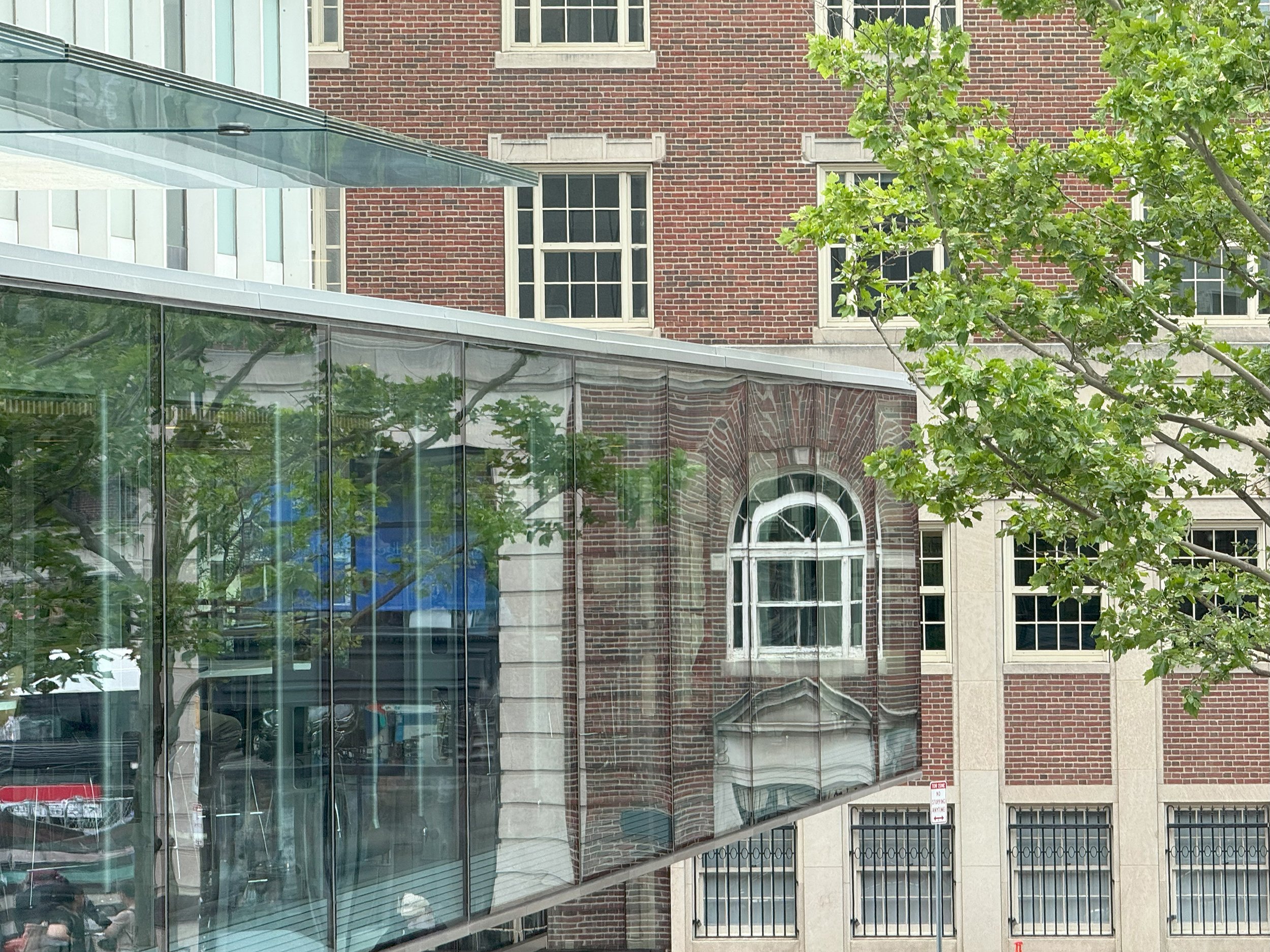
It finally rained during the last half of my last day in Boston and that rain ended up affecting my last scheduled tour ET164 From Plan to Action: Designing a Resilient Learning Hub, a bad name for a good tour of the new Center for Computing and Data Sciences Building at Boston University designed by KPMB Architects. The building goes all in on cantilevers and is somewhat iconic on the exterior, something I’ll get better pictures of the next time I go to Boston, whenever that may be. Luckily I did manage to snap a reasonably good picture of the building from the bus on the way back from the MIT tour, and also walk by a reasonably accurate model of the building on the tour.
Luckily to compensate for the lack of exterior views, we were given a comprehensive tour of the building’s often spectacular interior spaces, from the top floor mechanical room (not pictured) to the first floor lobby, and just about everywhere in between.