Page 2 of 5
Potomac, Maryland
Don't go back to Rockville
The primary reason for this road trip was a visit to Glenstone, a museum located in a residential area in Maryland northwest of Washington DC. The museum is free but requires reservations, and since they limit the amount of available slots so that it doesn’t get too crowded, securing this somewhat elusive reservation was the first thing that I did before finalizing any dates and booking any hotels.
We’ll go through the Glenstone pictures in chronological order (something that is not especially consistent throughout the rest of the slideshow), and you’ll experience Glenstone just like I experienced Glenstone on a generally rainy, cool Friday in May. I started this adventure by leaving my hotel in Rockville, Maryland for the 20 minute drive to Glenstone on mostly local roads, listening to R.E.M.’s Don’t Go Back to Rockville on a continuous loop the entire time. This was not necessarily a commentary about any ill feelings I may have about Rockville, Maryland (or whatever Rockville R.E.M. was actually singing about) but rather a chance to badly sing along about not going back to Rockville on a day and at a time when I was leaving there without plans to return.
I arrived at Glenstone (where there was no cell signal but luckily free wifi throughout), parked in the gravel lot and checked in here at the arrival hall. Now all we need to do is go left past this tree and see what’s next.
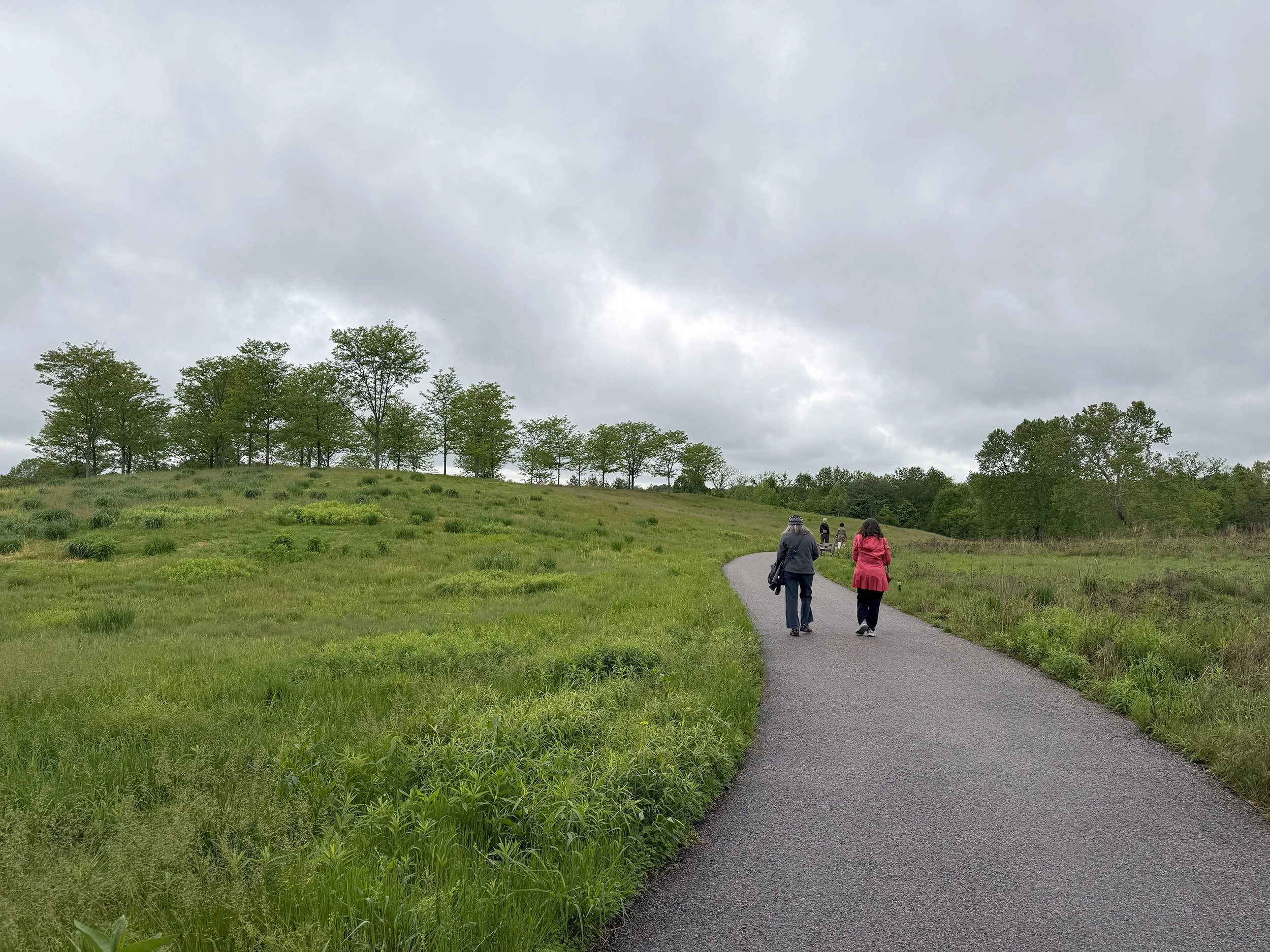
If you’re going to Glenstone you should be prepared to walk. Nothing is too long or too difficult, but there are hills and there is some distance between the entry and where you want to go. For me, I decided to take the long way by taking the first left where a monumental Jeff Koons sculpture waited for me on top of the hill.
In early May, Glenstone was still finishing up planting Split-rocker, and it was certainly an interesting time to see it. This is my third Split-rocker, having seen the one in Rockefeller Plaza and then again at the Fondation Beyerler in Basel. While the other locations were certainly interesting, it seemed most at home here peeking over the top of the hill at Glenstone as it got all decked out for the summer.
After Split-rocker, I continued on the Woodland Trail all the way to the Gwathmey building, experiencing art along the way during a fortunate break in the otherwise light and steady rain. The grounds were interesting in that there was a lot of space between the sculptures, unlike other sculpture gardens like Storm King or the Pepsi Sculpture Gardens, you rarely (if ever) could see more than one sculpture or installation in your frame of view.
The rain was starting to pick back just as I headed to the absolute highlight of Glenstone, a museum building called Pavilions designed by Thomas Phifer that is jaw droppingly spectacular. It is mostly a level below the hillside with super high gallery towers that are best seen from inside but that still look pretty good from outside as well.
Glenstone has an old school no photography policy if you’re inside, but all is fair once you step out into the open air. So even though I have only my memories of the inside of the pavilions (I’m ok with that), I was still able to step outside in the underground courtyard in the rain to take these pictures. (The) Pavilions are organized around a central courtyard with all of the galleries located along its continuous circulation path. A great experience to walk through and one that you’re just going to have to believe me is actually great since (as I already said) interior pictures were prohibited.
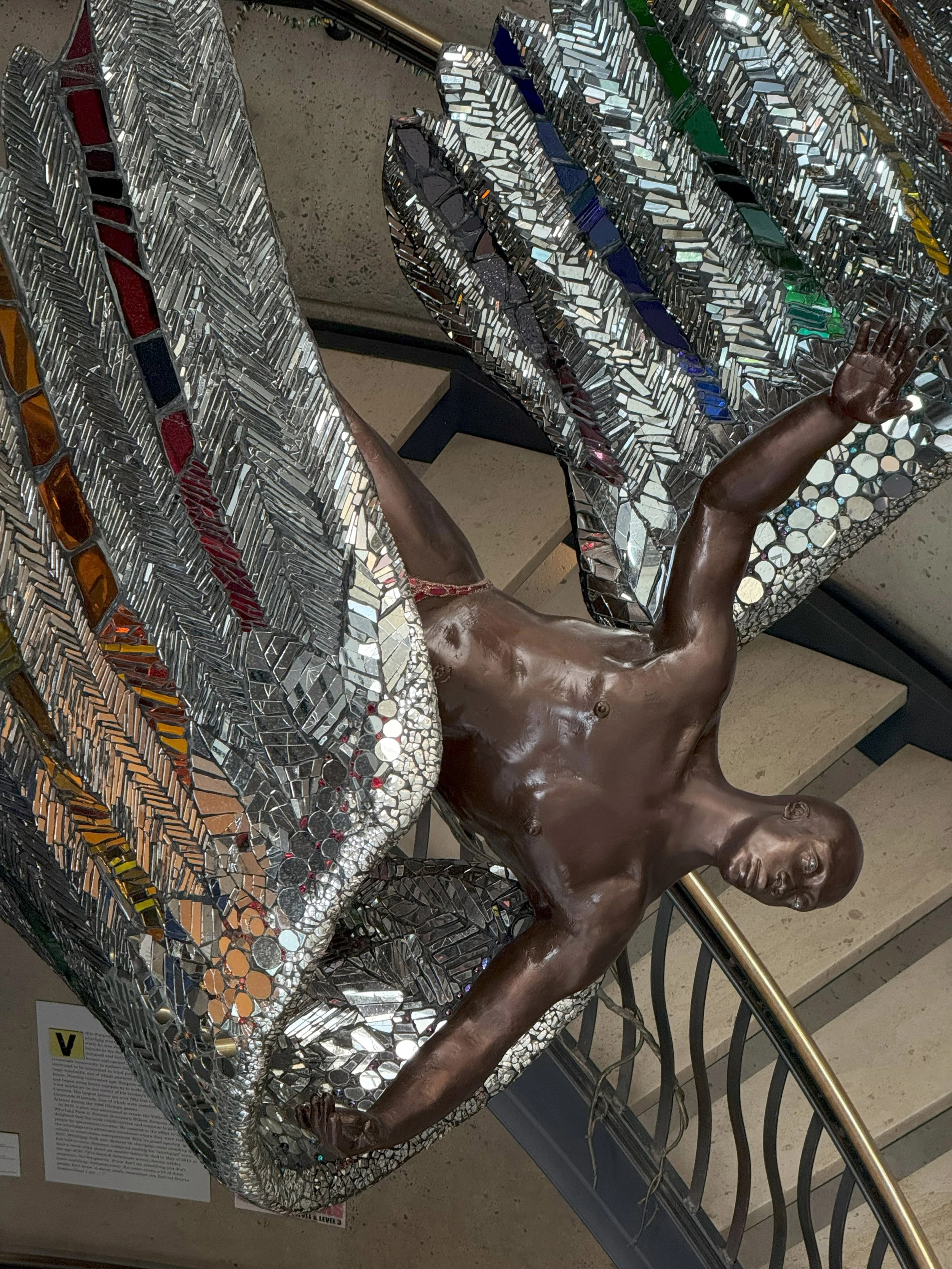
You’re only seeing a bit of what I saw. I was there about three hours and walked over four miles during that time, although some of that was me looping through the Pavilions over and over or doubling back on trails to resee things I already saw. Before we leave Glenstone, we’ll look back at some of the art on the grounds by artists including Tony Smith, Richard Serra and Alex Da Corte.
This was my first time at Glenstone but most definitely will not be my last. I’m already looking forward to coming up with some flimsy excuse to justify another road trip that just happens to include another trip to a place I waited way too long to visit in the first place. Maybe I’ll end up going back to Rockville after all.
The rain had just about stopped after I left Glenstone, so I decided to continue on and visit nearby Great Falls (of the Potomac) Park, which is part of the Chesapeake and Ohio Canal National Historic Park and includes overlooks of that Great Falls at both the Maryland and Virginia sides. The canal here is on the Maryland side, it’s the same canal that runs right through Georgetown in DC, and a canal that we’ll run into again later this slideshow.
I went to both sides in both states knowing full well that the Maryland side would be a better experience, and it certainly did not disappoint. From the canal, a short boardwalk trail extends over to Olmstead Island and through an area that the interpretive signs describe as one of the best preserved bedrock terrace forest ecosystems, a fact I would have never determined on my own without the sign.
The trail has even more to see than that well preserved bedrock terrace forest ecosystem, it also bridges over several tight channels of the river which was absolutely roaring after that earlier rain.
Even though the rain had just about stopped, the park was pretty quiet for a Friday afternoon and I had the entire Maryland Great Falls overlook to myself. The river flows from right to left (as opposed to uphill) and the opposite bank is on the Virginia side of the park- if you’ve been there before you can probably pick out some of the three overlooks on that side. The two parks are about a 20 minute drive away from each other. separated by local roads and a short, one exit ride on the Beltway, and while both sides were interesting, there’s a reason that all of my pictures are from the Maryland side.