Page 5 of 5
Sharpsburg, Maryland
Bones, dry bones in American towns
I started this road trip in Annapolis, driving across Delaware and Maryland after taking the Cape May - Lewes Ferry from New Jersey. After Annapolis I went to Baltimore, Glenstone, Great Falls, Harpers Ferry, Harrisburg, Strasburg and finally Valley Forge. This slideshow somewhat follows that trajectory, although some things like Baltimore were arbitrarily moved around and a few other destinations were left out until now, for good reason. Those two destinations were Antietam and Gettysburg, and this last page starts at Antietam.
Antietam is in Maryland but also close to Harper’s Ferry, close enough that Confederates were forced to walk the 18 miles on the day of the battle in September 1862. Antietam was a one day battle, but it was one hell of a day that saw over 22,000 people die, a one day American record that still stands today. It was also home to the most important battle of the US Civil War. It was a very costly Union win that repelled a Southern invasion giving Lincoln cover to announce the Emancipation Proclamation which politically prevented European powers from intervening and backing the (still) slavery supporting South.
I am not a Civil War expert or someone who dresses up like a soldier to pretend shoot Confederates, but I am always fascinated by history and have seen that Ken Burns documentary multiple times, even rewatching the Antietam episode the night before my visit. I have just enough knowledge of the war and the battle that certain places have meaning to me, and a visit to Antietam felt more like a pilgrimage than a stopover.
I had three main sites I planned on visiting at Antietam. Starting at the Visitors Center and Dunker Church (see previous photos), I walked through the fields to the second site at the sunken road. Here Confederates held the road and used it to shoot US soldiers, but eventually their good spot turned bad. The US soldiers eventually got the high ground and took out the Confederates who ended up stacked four or five bodies deep in that now peaceful looking road.
Of the three sites on my Antietam short list (the Dunker Church, the sunken road and the bridge), my favorite was the bridge, or to be more accurate, Burnside’s Bridge over the actual Antietam Creek, looking its best on a beautiful spring day 162 and a half years removed from its darkest day. Here a small number of Confederates held the high ground while the Union Army tried and eventually crossed it.
Another view of Burnside’s Bridge at Antietam, where you can see the bridge, the hill, the Confederates on the high ground as the US Army pushed its way through. This model is not in Maryland but instead in Harrisburg at the National Civil War Museum which is hard not to like but even harder to actually love.
The National Civil War Museum is located in Harrisburg, a city with no real connection to a war that physically touched so many places. It’s not even downtown but instead in an almost suburban park on top of a hill, a place that feels like it could be anywhere when you’re there. It has all of the things you might expect from a Civil War Museum but no specific artifacts or presentations that made it really stand out, with one exception. There are videos of some guy (probably a historian who is never identified or credited) who runs through every important battle chronologically in a compressed, minute a battle format. For Antietam, he said that in Antietam the deaths were equivalent to someone dying every second of every minute for six hours straight, a pretty good explanation of how horrible that place was.
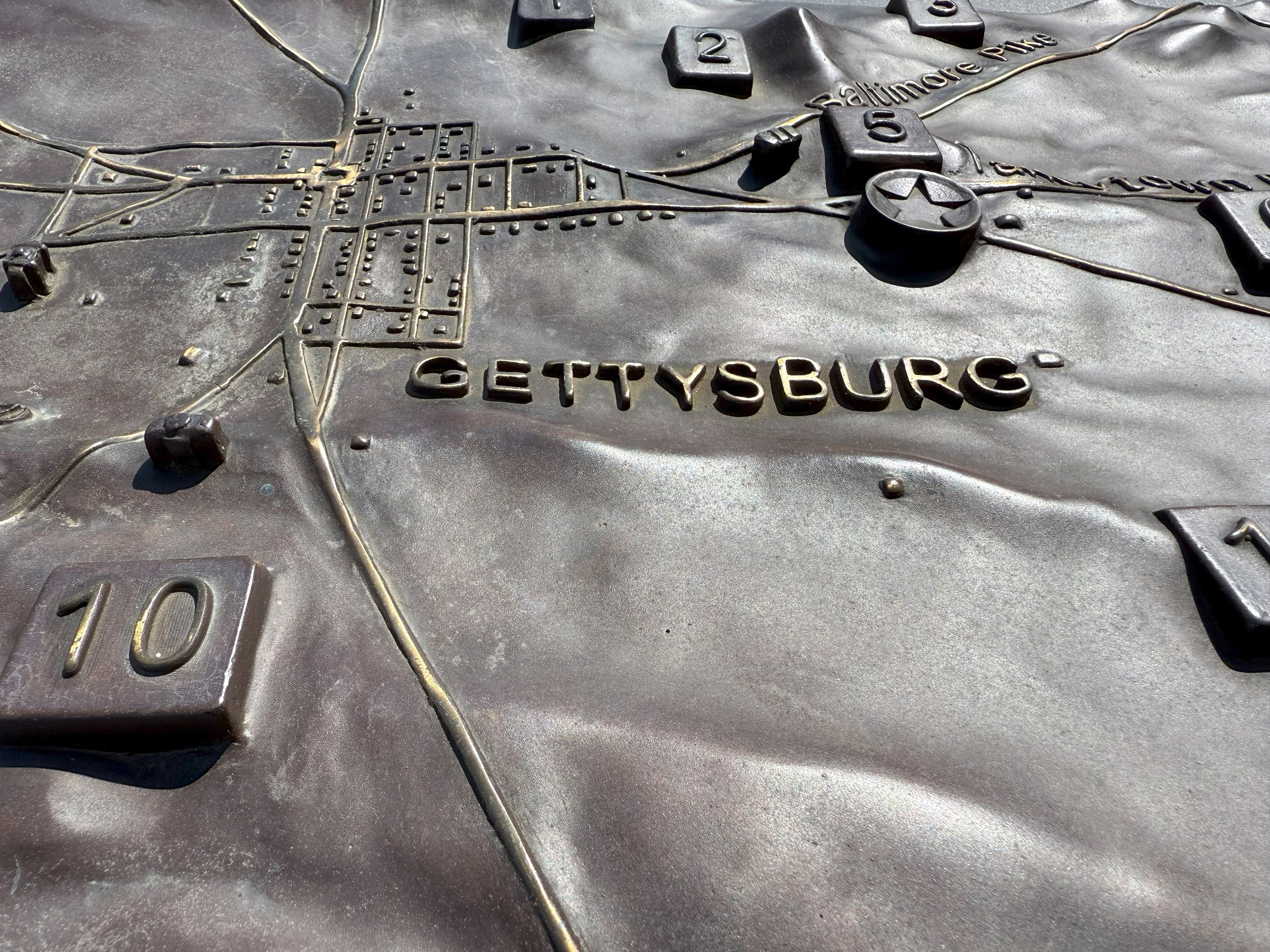
We’re ending the slideshow at Gettysburg, Pennsylvania, and we’re starting our visit at the visitors center. This wasn’t my first visit to Gettysburg, although the last one was so long ago that the original Richard Neutra designed building was still standing. What’s there today is nothing special architecturally, but inside they have a fantastic movie, better exhibits (by far) than the National Civil War Museum in Harrisburg and an improved cyclorama experience, although some of the “light show” parts of the presentation are honestly kind of cringy.
I had two main goals during my time at Gettysburg, not counting the Cyclorama. The first was a visit to the High Water Mark of the Confederacy and an out and back walk of Pickett’s Charge. I did it in reverse, starting at The Angle, then walking across the open fields to Seminary Ridge before turning back and going in the right direction in that utterly hopeless long march back toward the Union lines.
As I read (or watch documentaries) about the Civil War, I often find it hard to sympathize with the Confederates. I know that the soldiers were working class men who never owned slaves, but it’s also kind of impossible to imagine that those soldiers didn’t realize they were fighting for slavery and against those trying to end it. So walking the entire length of Pickett’s Charge, across fields totally by myself (no other visitors but me thought it was a good idea apparently), it’s hard not to imagine what it was really like that day, and how those soldiers must have lied to themselves to think they would ever even have a chance to make it across that field alive.
My last goal at Gettysburg was to drive up to Little Round Top, find a nice rock and wait out the sunset. I wasn’t the only person who had this idea, and everyone (including me) eventually found themselves taking pictures behind this statue of Brigadier General Gouvernor K. Warren, a Civil War Civil Engineer who understood the importance of Little Round Top early on and, as a reward, his statue gets the best sunset view every day.
With that it’s the end of another road trip. Eight hundred miles (or so) across five states, one ferry, two state capitols, five National Park Service sites and, all things considered, visits to a lot of places I had never been before. There are probably more of these road trips to do, maybe I’ll even find myself in Rockville again one day despite R.E.M.’s recommendations. One never know what the future really holds.