Page 1 of 3
Boston, Massachusetts
I close my eyes and it slips away
Every year I look forward to the upcoming AIA Conference and make plans to attend no matter where it takes place, and for the past few years the AIA did their best to test that theory by holding conferences in city after city where they had already held conferences before. Places like Chicago (2022 and 2014) , San Francisco (2023 and 2009) and Washington DC (2024 and 2012). This year was more of the same as the AIA Conference on Architecture returned to Boston and, since I already made plans to attend no matter where it takes place, I returned to Boston too.
That return by the way was a long time coming. For no particular reason, I don’t really go to Boston all that much- in fact it has been just over a decade since my last time there. A trip up to Boston is just about as easy and close for me as a trip to Washington DC (only about an hour longer on a comfortable enough Acela train), yet I’ve been to DC sixteen times since I’ve last been to Boston. There are a lot of asterisks in that number, things like the pandemic and AIA24 and the summer NBM installations all those trips for the Arlington funeral but still it’s hard not to look at that and make you think that maybe, just maybe, the AIA got it right this time and another go around in Boston is long overdue.
After easy enough morning rides on New Jersey Transit and Amtrak, I found myself back in Boston before I knew it. From South Station I took the Silver Line right to my hotel and then found myself in a completely new world. In the last ten years as I inexplicably stayed away, Boston was busy creating a completely new (and nice) neighborhood (the Seaport) in the area between the convention center and the ICA. There were restaurants, parks and people in areas I only really remembered as bleak parking lots.
My favorite building in Boston is still right where I left it, even if it is now surrounded by a city instead of open asphalt. This is ICA Boston by Diller, Scofidio + Renfro, perhaps the most Diller, Scofidio + Renfro-est of all their buildings. It still looks pretty good ten years later and all of the fun parts are still fun- that death defying media lab, the giant room sized glass elevator, the unexpected vertical light in the stairs and even the great big windows looking out at all those brand new buildings now surrounding it. As for the art inside the ICA, well, it was actually pretty good although for me it didn’t have to be. I came there to see the building.
When I went online to check out visitors information for the ICA, I was surprised to learn that ticket options now included a boat ride. The ICA expanded to a second space across the harbor in East Boston, and small water taxis shuttle visitors back and forth every 15 minutes and (according to the ICA) reservations are strongly recommended. I can understand why- these boats were pretty small and can’t really move all that many visitors- but for me visiting on a pleasantly quiet Tuesday afternoon, the boats were only half full at best.
As for the actual ride, it was probably only about ten minutes but it included some of the best views of Boston I would get all week.
The second ICA building across the harbor is called the Watershed and here it was all about the art and not at all about the building. Watershed featured a single artist installation, a wonderful walk through work by Chiharu Shioto called Home Less Home. This was not the first jaw dropping Chiharu Shioto exhibit I have been to- back in October 2015 I saw her installation at the Japan Pavilion at the Venice Art Biennial where it was (by far) my favorite in that whole show. Here in Boston there are no keys (the Venice Art Installation was all about keys) but instead it was a large installation in a large room that you can experience from the inside or outside, and one that was wonderfully easy to get lost inside (or even outside) of.
The last AIA Conference I attended in Boston was in 2008 back when the Big Dig was all finished but the greenway looked like lawns covering a great big open gash and not much else. Today all these years later it has grown in and feels like part of the city, something which was hard to see seventeen years ago.
I’m old enough to remember the elevated highway that once stood here and this part of the city is so, so much nicer with all of those cars out of sight. I know it was disruptive and expensive, but I really wish that more cities followed Boston’s lead and buried their loud, noisy, polluting downtown highways deep underground. Imagine what Toronto would be like if the Gardiner Expressway was gone or how much nicer Lower Manhattan and the South Street Seaport would be if the FDR wasn’t there. To imagine what it would be like, all you need to do is go to Boston and walk the greenway and dream.
After the ICA and the greenway, I walked over to the North End historic area to explore a little. One good thing you can say about Boston is that it’s walkable, almost everything in the city (discounting longer trips to places like Cambridge) are close to each other. For comparison, walking from the ICA to Old North Church is probably just about the same distance as walking from the Capitol Building to the Washington Monument in DC, although in Boston that same walk would have a lot more turns.
The area around the Old North Church is really quite nice and tying it to all of the historic sites is Boston’s Freedom Trail, a two brick wide line on the sidewalk that starts at the State House and connects churches and graveyards and historic buildings all over the walkable city. In all of the times I was in Boston, I only walked it end to end once, and that was on my very first family trip here when I was still in grade school. It’s probably time to think about doing it again, starting early and stopping by every single church, every single graveyard and every single historic building on the way. But today I’m going to have to settle for just crossing that trail a few times in the North End and stopping by to say hi to that statue of Paul Revere. I’m sure I’ll be back again before the next AIA conference in Boston which, if past is indeed prologue, should be sometime around 2042.
I’m not sure if it’s as bad as it looks, but damn, weekday driving in Boston looks like a nightmare. Cars were stacked into every entrance into that great big tunnel under the greenway, and every single bus I took on AIA tours was 15 to 30 minutes late getting back. And here on the Zakim Bridge it doesn’t matter if you’re coming or going, either way is going to take a lot longer than it should.
At (or near) Boston’s North Station were two hockey related statues, which is two more than most cities but still not nearly enough in a just and right world.
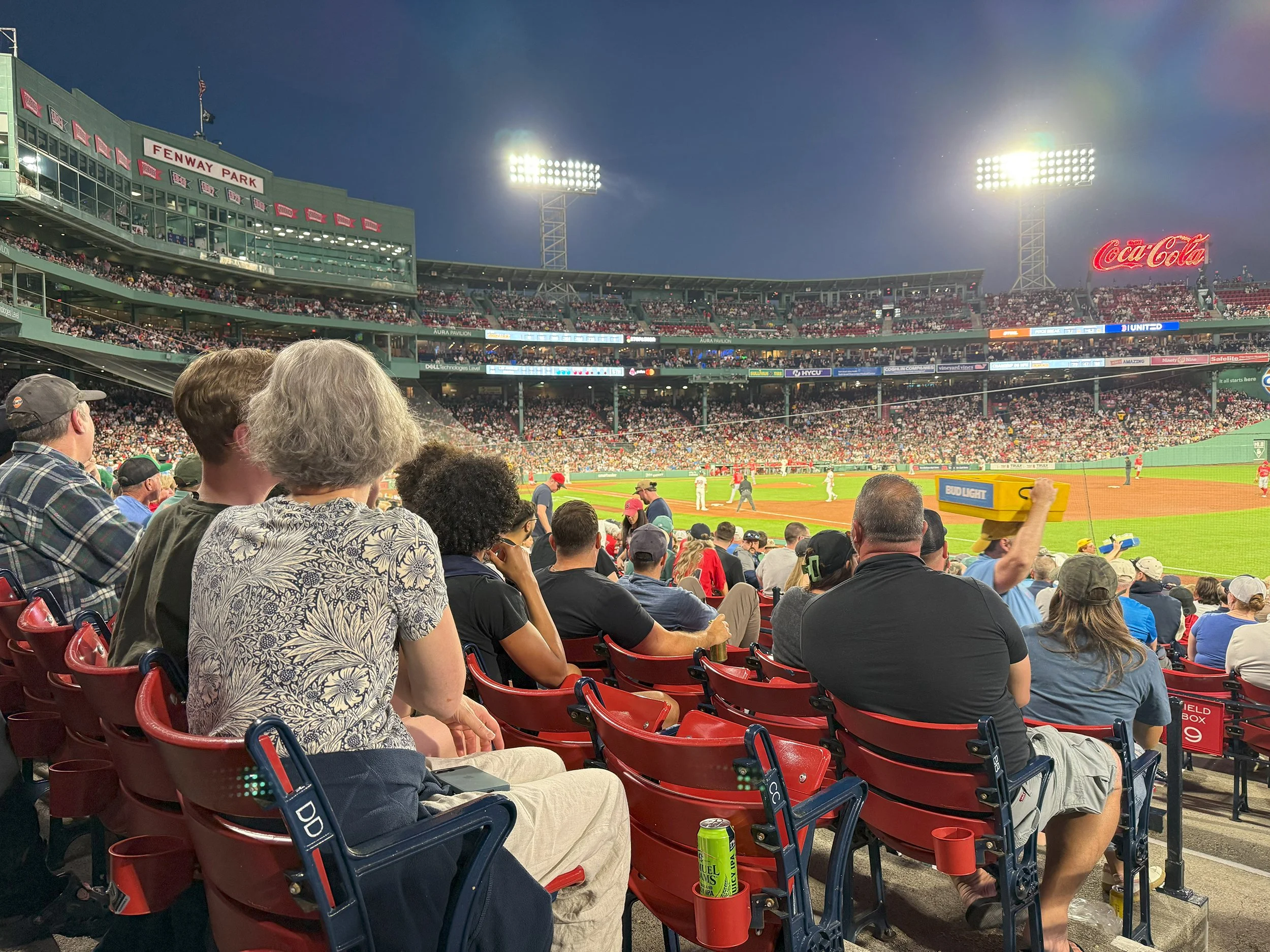
From North Station I was able to get a highly valued seat on a Green Line train to Kenmare to see a Red Sox game at Fenway. Long time slideshow viewers know that through circumstance and luck (and surprisingly little planning) I have visited 20 out of the 30 Major League Baseball stadiums and this visit to Fenway, well, it doesn’t change that number at all since I’ve been here before. In fact this was the very first stadium on that list, I went to a game way, way back on that family trip when I was in grade school. For that game we had covered seats back on the right field side for a Yankees - Red Sox game where we were unintentionally seated near a lot of Yankees fans who introduced my grade school self to all sorts of new, colorful R rated words. Ah, memories.
This time my seat was on the same side but a lot closer, and while there might have been fans present to support the opposing California (or I guess it’s now it’s the Los Angeles) Angels, I sure as hell didn’t see any during what could best be described as a forgettable game. But like the ICA and the art, I didn’t really come for the game as much as I came for the building. And that building is hard to beat.